 Audrey Campeau
This e-mail address is being protected from spambots. You need JavaScript enabled to view it
514-987-3000, ext 2927
Université du Québec à Montréal
Pavillon des sciences biologiques, SB-2805
2080 St-Urbain
Montréal, Québec
H2X 3X8
Canada
Postal Address:
Université du Québec à Montréal
Département des sciences biologiques
Case postale 8888,
Succursale Centre-ville
Montréal (Québec)
H3C 3P8
MSc, "Les émissions de dioxide de carbone (CO2) et de méthane (CH4) provenant des réseaux fluviaux boréaux: estimés régionaux actuels et réponse et réponse future face aux changements climatiques", Université du Québec à Montréal, 2012.
BSc, Université de Montréal, 2009
Interests:
Biogeochemistry of carbon, green house gases, carbon dioxide, methane, nitrous oxide, dissolved organic and inorganic carbon, gaz exchanges, hydrology of fluvial networks, groundwaters, wetlands, boreal ecosystems, peatlands.Research project:
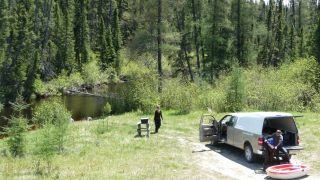
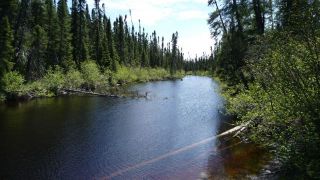
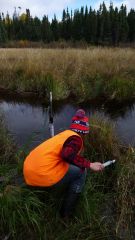
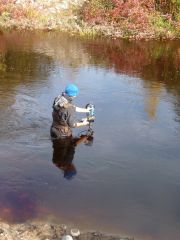
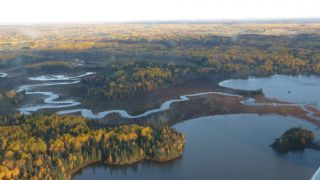
An accurate estimation of the anthropic and natural sources of emissions of green house gases (CO2, CH4, N2O etc.) becomes a major concern in the aim for modelling future climate changes. A lot of research indicates that inland waters (e.g. lakes, rivers, streams, ponds, wetlands) may act as a natural source of GHG to the atmosphere. Among these, the rivers and streams represent a connecting network between the terrestrial zone (watershed), groundwaters and lake systems. The boreal forest biome (taiga) covers the majority of the territory of Québec, from which an average of 12% is covered with inland waters. Yet, due to the remoteness of this region, very little is known about these ecosystems. My project is taking place in Western Abitibi, Parc National d’Aiguebelle and Southern James Bay. The objectives of my project are as follow:
1- Determine how the different components of physicochemistry, morphometry and biology affect the dynamics of GHG in rivers and streams of different sizes and regions.
2- Follow the whole year variations of these different factors and their impact on the GHG dynamic through different seasons in these regions.
3- Characterize the GHG exchanges between the surface water of rivers and streams, with the atmosphere.
4- Estimate the total output of GHG emissions from rivers and streams in these regions over a year